
Owners ask us two questions more than any others. How do I know if a property is a good investment? And if it already has a tenant, should I sell or hold it?
Nobody can answer either one for you, and anyone who tries without asking about your finances or understanding your overall situation is just guessing. What we can give you is the framework we use: what an investment property pays you and how to measure it. With this, you should have a starting point for answering both questions, with your own numbers.
Start with your goals
A rental is a financial decision first. That sets it apart from the house you live in, which for many families is still the biggest driver of their net worth. Across all U.S. households, home equity is about 19% of net worth: $35.8 trillion of $185.7 trillion in the second quarter of 2026, per the Federal Reserve. For households in the 50th to 90th wealth percentile, it is about 31%: $16.4 trillion of $53.4 trillion.
But a home is about more than money. It is the school, the commute, the community and the kitchen. And you can't spend part of it. Beyond a HELOC or a refinance, getting that equity out means selling and moving.
An investment property has one job, which is to pay you. So the first question is what you need that asset to do: produce income now, grow for later, or some of each.
A rental is one asset class among many, so judge it like the others: by the cash it produces and the return it earns.
Two ways real estate pays you (or three if it is financed)
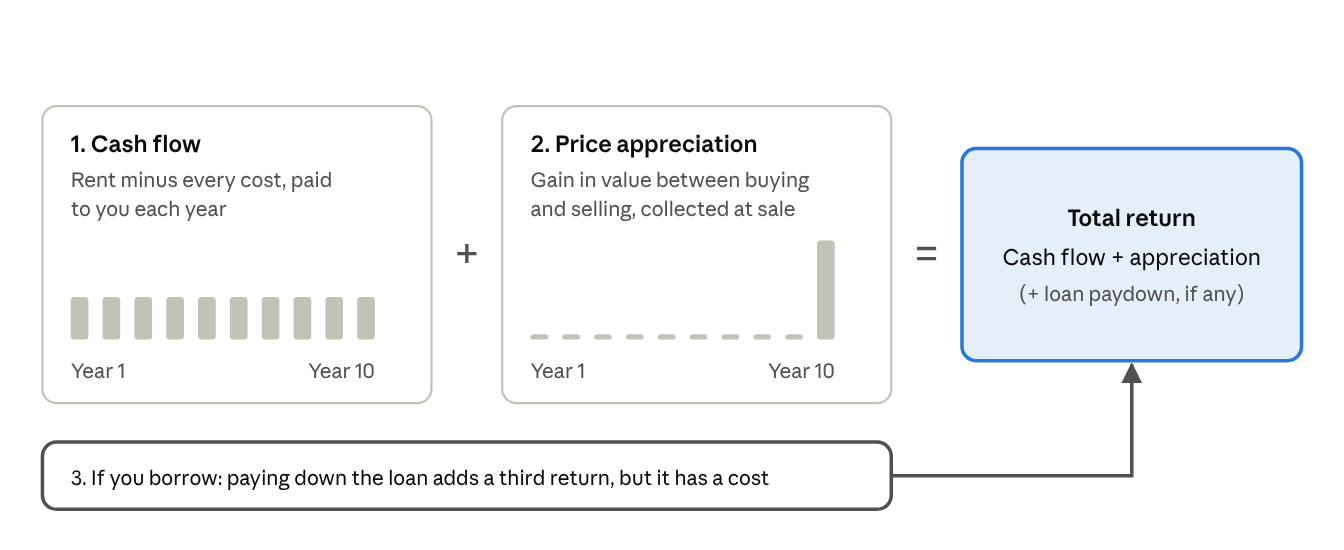
Cash flow arrives every year. Appreciation arrives when you sell. Together they are your total return.
Cash flow is the part you can spend
Cash flow is the real money paid to you each year, after every cost of owning the property. To compare properties of different sizes, use cash-on-cash yield: the year's cash flow divided by the cash you put in.

For a rental, cash flow is rent minus everything
Rent is the easy line; cash flow is what survives the rest:
- Property taxes and insurance.
- HOA or condo dues.
- Maintenance.
- Vacancy and turnover.
- Property management.
- Debt service, if you borrowed.
Just like family finances, it is important to understand and have realistic expectations for each of these. That is how a property that pencils well on a spreadsheet disappoints in real life.
Here is an example of the math with no loan. Buy a $400,000 condo with cash. Rent is $32,000 a year. After 5% vacancy and $12,200 a year in operating costs (HOA, taxes, insurance, property management and repairs), $18,200 is left. With no mortgage there is no debt service to subtract, so the cash-on-cash yield is $18,200 divided by $400,000, or about 4.6%.
Now, if you are judging this rental property just in terms of cash flow coming in, you would need to compare it against other income producing assets out there, perhaps another rental property, a bond or a dividend stock. But we now know that would not paint the whole picture, right?
Enter price appreciation...
Price appreciation: what the market adds
Price appreciation is the gain in value between buying and selling. It follows scarcity and the cash a property can produce for the next owner; a buyer pays more only when there are fewer homes to go around, or when the home earns more for whoever owns it next. Three forces move it most, and location decides how strongly each one applies to a given property.
We work in the Miami-Dade area, so we will focus this section on our territory. But the same factors apply when you are studying other markets. The figures below are county-wide, and a neighborhood or even a single building can move very differently.
Demographics: who needs housing and can pay for it. Miami-Dade is home to about 2.8 million people, roughly 12% of Florida's population, and it keeps attracting people from abroad. The Census Bureau lists it second, just behind Harris County, Texas, among U.S. counties with the largest net international migration in 2025. New investment and job creation follow that population. The same momentum has lifted prices across the board; the median home value is up about 50% in five years, and the $525,000 median sale price runs about six times local household income. Affordability is the pressure point to watch.
Construction and inventory: how many homes are for sale. Prices move with inventory. When many new homes reach the market, buyers have more choices and sellers compete harder; when fewer arrive, existing homes face less competition and hold their value. Builders pulled permits for 11,258 homes in Miami-Dade in the 12 months through August 2026, down 18% from the year before. Permits are not completions and lead them by a year or more, so a slower pipeline today means tighter inventory later, which tends to support the prices of the homes already built.
Interest rates: how many buyers can afford to buy. Rates set the size of the buyer pool. The 30-year fixed mortgage averaged 7.40% on October 8, 2026 (Freddie Mac). At that rate, $1,000 a month of principal and interest supports a loan of about $144,000; at 4%, the same payment supports about $209,000. Higher rates mean fewer buyers qualify at any given price, which holds prices back. Lower rates bring buyers off the sidelines and support prices.
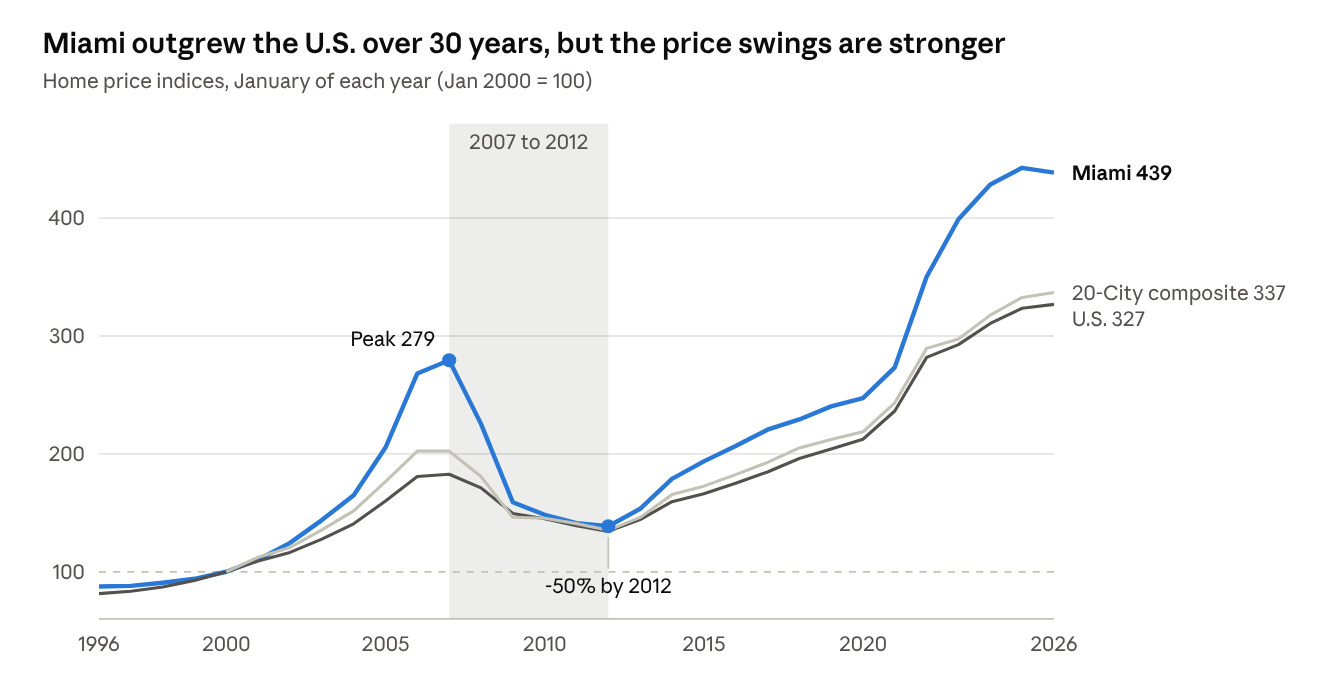
Again, we focus on the Miami-Dade market, but this same data series is published for 20 large U.S. metros, so you can run this check on yours. Over 30 years, Miami home prices rose about 5.5% a year and the U.S. about 4.7%. The ride has been uneven and more volatile for Miami. Past appreciation is not a forecast.
Leverage adds a third return, and a third risk
A mortgage builds wealth quietly. Take the same $400,000 condo and borrow $160,000, 40% of the price. You put down $240,000. A 30-year loan at 7.40% costs $1,108 a month, or $13,294 a year. The condo leaves $18,200 after operating costs, so after the loan payment about $4,900 a year is left as cash flow.
But every payment also includes principal, so your equity grows each month whether or not prices move. Here is how much of the loan you pay off:
| Year | Principal paid that year | Total principal paid | Loan balance left |
|---|---|---|---|
| 1 | $1,504 | $1,504 | $158,496 |
| 5 | $2,020 | $8,763 | $151,237 |
| 10 | $2,922 | $21,436 | $138,564 |
| 20 | $6,109 | $66,261 | $93,739 |
In year 1, only $1,504 of the $13,294 in payments is principal; the rest is interest. The principal share grows every year because interest is charged on a shrinking balance. By year 20 you have paid off about 41% of the loan, and that is adding to your return and to your wealth.
Know which source of return you're betting on
Properties tend to lean one way. Some pay more cash flow and appreciate less. Others pay little cash and depend on prices rising, such as a high-demand condo where rent barely covers the carrying costs. Some can do both well, but they are harder to find.
Neither is wrong, but trouble starts when you buy one and expect the other. If you are counting on appreciation, you are betting on a market, and you need the staying power to wait for it.
The leveraged condo over 20 years
Here is the same $400,000 condo with the $160,000 loan, held for 20 years and then sold. The inputs are illustrative: a 7.4% 30-year loan; year-1 rent of $32,000 rising 3% a year; 5% vacancy; $12,200 a year of operating costs, also rising 3% a year, which leaves the $18,200 from the earlier example; 4% annual appreciation; 7% selling costs.
| Year | Cash flow that year | Property value | Loan balance | Your equity (value minus loan) |
|---|---|---|---|---|
| 0: buy ($240,000 down) | -$240,000 | $400,000 | $160,000 | $240,000 |
| 3 | +$6,015 | $449,946 | $155,134 | $294,812 |
| 5 | +$7,191 | $486,661 | $151,237 | $335,424 |
| 10 | +$10,453 | $592,098 | $138,564 | $453,533 |
| 20 | +$18,620 | $876,449 | $93,739 | $782,711 |
| 20: sell (value less 7% costs and the loan) | +$721,359 | - | - | - |
Cash flow starts near $4,900 a year and grows to about $18,600 by year 20, because rents rise while the loan payment stays fixed. When you sell in year 20, the price less 7% selling costs and the loan payoff leaves $721,359. Add $223,167 of cash flow collected along the way and you get back $944,526 on $240,000 invested: 3.9 times your money, or about 8.2% total return a year.
If we play a bit with different price appreciation scenarios, we can see different results. Same property, same rent, same costs. Only the market changed.
| Annual appreciation | Return |
|---|---|
| 1% | 5.6% |
| 4% | 8.2% |
| 7% | 10.9% |
What about taxes and depreciation?
Some of you should be asking: what about the tax benefits from depreciation? And you would be right.
The IRS lets you deduct a share of a property's cost every year, spread over 27.5 years for residential property, even while the property may be rising in value. That deduction is not cash out of your pocket, yet it lowers the taxable income the rental produces, sometimes enough that a property with positive cash flow shows little or no taxable profit. Mortgage interest, property taxes, insurance and repairs are generally deductible as well. There are trade-offs: depreciation lowers your tax basis and is partly recaptured when you sell, and some rental losses can only be used in limited ways.
The numbers above do not include any of this. We will cover depreciation, deductions, recapture and exchanges in more detail in a future post. This one is about the basics.
How to decide
Line the property up against your alternatives: a bond, an index fund, paying down your own mortgage. For each, ask what it pays, what could go wrong, and how much of that you can live with. Then pick what fits your goals and how well you sleep.
That also answers sell or hold. Treat today's value, minus selling costs and taxes, as cash you could have. Holding means choosing to reinvest it in this property. Does the property earn more than your next best use of that money, after costs and risk?
At Suma PM, we manage residential rentals for owners in Miami-Dade. Part of that work is helping owners run these numbers on the properties they already hold or the ones they want to acquire. If you would like a second set of eyes on yours, we are happy to talk it through.
This article is education, not financial, tax or legal advice. Talk to your CPA before you sell.
Sources
Data as of Oct 9, 2026.
- Federal Reserve, Distributional Financial Accounts, via FRED (real estate, home mortgages and net worth by wealth percentile group, e.g. WFRBLN40056, WFRBLN40075, WFRBLN40080). Q2 2026. Home equity is real estate minus home mortgages; shares are our calculations.
- S&P Cotality Case-Shiller indices via FRED, January readings, not seasonally adjusted (the Miami index covers the Miami metro area): U.S. National (CSUSHPINSA), FL-Miami (MIXRNSA), 20-City Composite (SPCS20RNSA).
- Freddie Mac Primary Mortgage Market Survey: 30-year fixed-rate average, Oct. 8, 2026.
- U.S. Census Bureau: QuickFacts, Miami-Dade and Florida population estimates, July 1, 2025 (Vintage 2025); net international migration by county, 2025, released March 2026.
- U.S. Census Bureau, Building Permits Survey: Miami-Dade permits, 12 months through August 2026.
- Miami-Dade median sale price, five-year home value change and sale price to income ratio: municipal recorder-of-deeds data aggregated by RealAI, as of Sept. 30, 2026.
- IRS Publication 527, Residential Rental Property (2025): 27.5-year recovery period for residential rental property (Table 2-1).
- The $400,000 condo examples, including the 20-year hold and the appreciation scenarios, are our own calculations from the inputs stated above. They are illustrations, not forecasts.